

Difficulty level: 1 (simple, no special tools required)
 Printer-friendly assembly instructions in pdf format
If you want to purchase this inexpensive and simple kit, click here.
Read all instructions carefully and check the Safety Rules before you start!
Introduction
This is our version of well known simple motor. There are lots of variations of similar motors on the internet. However this conventional motor kit provides the ability to do some experiments with it.
You may build one of four configurations with one or two magnets placed at the bottom, top, or on the sides and experiment with 4 different voltages: 1.5, 3, 4.5 and 6 Volts using included jumper wire. You also may experiment with different size wire coils.
If you add RPM measurement kit or attachment you may actually get real time speed measurements!
For schools we provide simplified version of this kit (sold in sets of 10) for only $4.99 per motor!
If you want to compare regular ceramic and very strong neodymium magnets and experiment with the distance between the magnet and the coil you might be interested in our kit #16.
Please note: Though this kit looks like the simplest motor it requires a lot of accuracy in balancing the coil and stripping off the insulation. It is also not a very reliable motor. It is actually easier to assemble any of the reed switch motor kits shown at our site. They are much more stable, reliable, may run non-stop for a long time, and are powerful enough to do some work while practically nothing could be attached to this motor.
This is not a brushless motor as opposed to most other motors on our site.
Instructions
- Leave about 3″ (7-8 cm) and wind the wire 10-35 times around the AA battery. You do not have to be neat as some randomness does not affect the motor performance and may help the coil to hold its shape better. Leave 3″ (7-8 cm) at the other end of the coil.
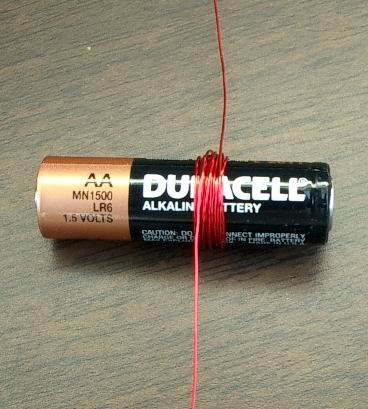
- Carefully remove the battery and wrap the ends around the coil 2-3 times to hold the coil together with both ends extending perpendicular to the coil as shown below. The ends should be aligned in a straight line to form a good axle. This step requires a lot of accuracy because the balance of the coil is extremely important.

The kit contains enough wire to experiment with the coils of different size (10 and 30 windings shown).
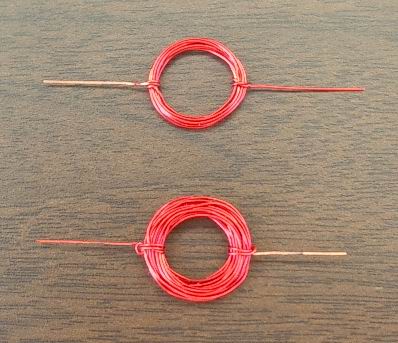
- Strip off the insulation completely at one end and only half of it at the other. This step is very important, try to be very accurate.
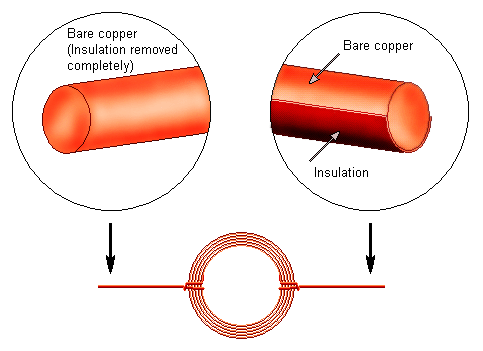
The following picture shows how to remove the insulation using the knife. Do not scratch the table – put a piece of cardboard or similar material on it. Hold the coil in vertical position with one of the ends lying on the surface and remove the insulation by moving the knife in the direction shown with the arrow. Hold the blade of the knife in vertical position. You will need to rotate the coil slightly in both clockwise and counterclockwise directions to remove half of insulation, and rotate the coil 360° to remove the insulation completely from the other end. Apply only a slight pressure or you may cut the wire end off.

- Fully insert two metallic stands into predrilled holes in the board. You might need to push hard or even hammer the stands into the board.

- Attach the battery holder to the board and connect its wires to the stands as shown below. You may need to cut the wires to the desired length. Do not forget to remove the plastic insulation at the ends of the wires.

- The battery holder and a jumper wire included in this kit allow you to experiment with 4 different voltages: 1.5, 3, 4.5, and 6 Volts. To understand how the jumper wire works let’s take a look at the connections inside a typical battery holder:
 The following diagram shows how to get 1.5, 3, 4.5, and 6 Volts using 1, 2, 3, or 4 batteries and a jumper wire shown in blue color. Arrows show the current flow for 1.5, 3, and 4.5 Volts settings. Could you trace the current when all 4 batteries are inserted (there is no jumper wire in this case)?

Inspect your battery holder – it may have different connections inside. In this case you can still use the jumper wire in the same manner to get all 4 voltages, but you will need to find appropriate connection points for each voltage setting.
Insert bare ends of the jumper wire between the spring and plastic case to make a good contact and hold them in place.
- Glue the magnet to the board between the stands as shown on the next page. Place two beads on the coil ends. These beads reduce the friction between the coil and the stands. Now place the coil on the stands and try to spin it slightly. Well balanced coil should spin freely. Ideally it should stop in random positions. Take time to balance it. You might need to move the ends up and down along the coil slightly to find the most balanced position. After you balance the coil you may add couple drops of glue where the ends meet the coil to prevent future sliding.
Connect the battery and the jumper wire. Depending on the coil position the motor may start immediately or you might need to give it a slight push. The motor usually spins in one direction so you should try to spin it slightly in both directions.
You can make this motor run faster by using two magnets. You will need a piece of sturdy material like heavy duty cardboard to make a crossbar. Piece of pencil is used in the motor below. Glue two stands to the board as shown in the picture. Before attaching the second magnet to the crossbar find the proper magnet orientation. Hold a second magnet over the top of the motor while it is running. If you move the magnet closer to the coil it may run faster or slower depending on which pole is facing the coil. Hint: one of the poles is marked on all supplied magnets (either with letter ‘S’ for the South pole or a dimple for the North pole) and to make the motor faster North and South poles should face each other. After you find the proper magnet orientation glue the magnet to the crossbar and the crossbar to the stands.
You may have the magnets placed sideways as shown in the pictures below. However, when you strip half of the insulation as explained in step 3 you should lay the coil flat on the table or hold it so it is in a horizontal position.

This is the motor with two magnets on the sides.

Start with one 1.5 Volts battery. If the motor does not work, add another battery to increase the voltage to 3 V. If it still doesn’t work, ensure that the rotor is balanced and can rotate freely and check the insulation. Properly removed insulation leaves shiny copper on one end. Half of the other end should also have shiny copper color while the other half should be the color of the original insulation as shown in step 3. Make sure the batteries are fresh and connected properly. If the motor still does not work – check Troubleshooting section at our web site.
CAUTION: Do not leave the motor connected to the batteries if the rotor is stalled. This motor consumes a lot of electricity and could drain the batteries quickly even if it does not spin.
How it works
When un-insulated (bare copper) parts of the coil wire contact the metal stands the current from the battery flows through the coil making it an electromagnet with North and South poles. This electromagnet interacts with the permanent magnet (North and South poles attract each other while the same poles repel). Motor starts to spin until the contact is broken when an insulated part of the coil end comes into contact with the stand. However, the coil continues to spin due to inertia and then the process continues. Technically speaking this motor is a single pole pulse motor.
3 Comments
nice! helped me a lot!
it’s great !!!
Cool